Monday, November 21, 2016

What Now Don Quixote, Another Windmill? - The DD-963 Spruance Class Destroyer circa 1975

As a means of provenance and establishing bona fides the following is a framed copy of the original conceptual artwork by the Litton AMTD artist Russ Vickers rendered in 1970. The original was received by the Navy in July 1970. Probably as part of the massive proposal package delivered at that time. To the best of the author’s knowledge it has only existed heretofore on the Internet as a black and white copy available through the United States Navy’s photographic archives.


In 1970 I was working for Honeywell’s Marine Systems Center as a staff engineer responsible for maintaining a current threat analysis of the then Soviet Submarine Force, as well as defining the requirements for future U.S. Navy anti-submarine weapons systems.

At that point in time the Navy issued an RFP (Request for Proposal) for a new class of destroyer, whose primary mission would be ASW (anti-submarine warfare), the DDX.

In anticipation of the RFP Litton Industries had already formed a new division, AMTD (Advanced Marine Technology Division), initially located in Culver City, California (metropolitan Los Angeles). The division was subsequently transitioned to the new Ingalls Shipyards at Pascagoula, Mississippi, expressly built by the company to execute the construction of a new class of US Navy destroyer.

Given our established experience in the development and production in ASW weaponry, reflected, in the ASROC (RUR-5) ASW weapon system, and the MK 46 acoustic homing torpedo which comprised one of ASROC’s payloads, Honeywell was signed under contract as a partner to Litton. Our responsibility was to develop and integrate the total ASW weapon suite for the DDX. An essential element of that suite was the development and production of the US Navy's first digital ASW weapon control system, the ASW Weapon Control System Mk 116 Mod 0.

My responsibilities encompassed working with the U.S. Navy in the Threat and Mission Analysis which would insure that the totality of the sensor, fire control, and weapon systems installed in the ship were fully responsive and effective against the projected Soviet submarines which would be operational, as well as under development when the DDX was built and deployed at IOC (Initial Operational Capability). By that point in time in my civilian engineering capacity I regularly attended briefings and participated in the development of studies for the then National Security Industrial Association (NSIA; now NDIA-National Defense Industrial Association) in the field of anti-submarine warfare. At the time of initiating our studies for the DDX I had recently attended a detailed briefing by U.S. Naval Intelligence of a brand new second generation of nuclear submarines, the CVY (Charlie, Victor, Yankee Classes) of SSGN, SSN, and SSBN submarines. All three of these classes incorporated a second generation nuclear plant, and a significantly reduced acoustic signature. It is important to note that the intelligence had been gained in 1968, and the classified briefing disclosing it to the civilian ASW community, in either 1969 or early 1970.

As a brief aside, the then President of the NSIA was Frederick “Fred” Silverthorne, who had retired from the United States Navy as a Captain, and as a decorated (Distinguished Flying Cross and five Air Medals) Naval Aviator had flown catapult launched Curtiss SOC Seagull floatplanes off the heavy cruiser force during World War II. In a rather strange and unique set of coincidences, after his stint with NSIA, Fred was elected to the position of Mayor of Fairfax, VA, and subsequently retired with his wife Bette to Sun Lakes, Arizona, becoming almost our next-door neighbors. Fred and I became very close friends for the remainder of his life.


A Curtiss SOC floatplane being recovered and repositioned
on the port catapult of the USS Minneapolis (CA-36) on
5 October 1943 following a bombardment of Wake Island


 Two Curtiss SOC-1 floatplanes positioned on the catapults
of the Omaha Class light cruiser USS Cincinnati (CL-6)

In a parallel career I had been fortunate enough to have been promoted to Commander in the U.S. Naval Intelligence Reserve Program. My two weeks active duty each year had afforded tours of duty with major fleet/shore commands including, COM3rdFLT, COM1stFLT, COMNAVAIRPAC, Naval Intelligence Command (NIC) Headquarters, NFOIO (Naval Fleet Operational Intelligence Office), and CNO Intelligence Plot, working specifically in the field of ASW. The combination of these two avenues of access afforded me a reasonable knowledge of the Navy’s established intelligence on both the current and future Soviet Submarine Force, and its operations. I had been fully aware of the emergence of the Soviet CVY Group since shortly after the development of the initial intelligence. “Need-to-know” limitations had precluded my use of this knowledge in my civilian position until the NSIA briefing. The following photographs in sequence are the Charlie I Class SSGN, the Victor Class SSN, and the Yankee Class SSBN. The viewer can discern the bulbous shape of the Charlie I bow, as well as the large hatches over the vertical tubes (not horizontal) housing the SS-N-7 missiles.

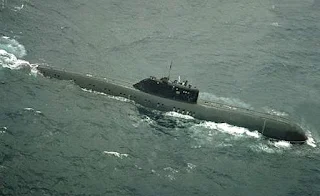


As an integral and essential element of the RFP for the DDX, the Navy’s Ship Systems Command Program Office developed a series of threat scenarios which defined the operational requirements to which the ship and its combat system were to be able to effectively respond. You can perhaps appreciate my shock and disbelief when we received copies of the DDX RFP, and the accompanying SECRET/NO FOREIGN annex which incorporated the detailed threat scenarios. As the projected threat to the DDX (IOC 1975) they had defined the then decade old November Class SSN (IOC 1958) firing torpedoes. These at that time included the Type 53 and 53-56 series, 53-65K (wake-homing), the ET-80, the early ET-60 series, and a torpedo with a nuclear warhead option, with launch ranges between 20 and 24 kyds (exception nuclear warhead), at speeds between 44 and 45 kn. The November Class boats were capable of a very respectable submerged speed of 30 kn.


The Soviet Navy 53-65K wake homing torpedo (IOC 1965)

The following photograph purports to be of the Soviet T-5 nuclear torpedo. It is from open sources. Given the inherent secrecy of Soviet weapons programs, let alone nuclear weapons, combined with the translation of the Russian language to English, the photo and weapon's characteristics, even though dated from the mid 1950's, should be considered provisional.

T-5 Torpedo
IOC: 1958 (only remained in operational inventory for 2 years, but not known at the time)
Diameter: 553 mm (21 in.)
Length: 792 cm (25.98 ft)
Propulsion: Electric/Combined cycle
Range: 10 km (5.4 nm)
Speed: 40 knots
Warhead: Nuclear (nominal 3 kt yield)


The Soviet Navy T-5 nuclear torpedo (IOC 1958)

The new Charlie Class SSGN had been established as capable of submerged launch of up to eight SS-N-7 Starbright (Soviet designation; P-70 Ametist/4K66) cruise missiles with an operational range of 35 Naut. Mi. at Mach 0.9. The warhead being either 1,170 lbs of high explosive or a nominal 200 kt nuclear yield. For comparison the Hiroshima nuclear weapon had a yield of approximately 15 kt. The submerged speed of the submarine was 24 kn. To put this into stark perspective the Navy’s Program Office had stipulated as the projected threat baseline a submarine that was already a decade old, and torpedoes not missiles, for a new class of destroyer with a projected IOC of 1975, almost two decades differential. This directly in the face of verified intelligence that an entire new second generation of Soviet submarines (with submerged cruise missile delivery capability) was at that very time being deployed in series production.


The SS-N-7 Starbright (P-70 Ametist/4K66) cruise missile


Litton was successful in winning the contract for the DDX, which now became known as the DD-963 Spruance Class destroyer, named after ADM Raymond A. Spruance who commanded U.S. naval forces during two of the most significant naval battles of WWII that took place in the Pacific theater, the Battle of Midway and the Battle of the Philippine Sea .

In one of the first design reviews scheduled by the then Navy’s Ships Systems Command (then NAVSHIPS, now Naval Seas System Command – NAVSEA) Program Office for the DD-963 I had the opportunity to review my work to that point with two LCDRs (Lieut-Commanders) from that office. Their names will remain anonymous. I expressed my grave concerns regarding the fact that in 4 out 5 (or 6, unfortunate lapse of memory) of the detailed threat scenarios provided, that the November Class SSN was able to achieve effective launch range of the stipulated operational Soviet submarine torpedoes, prior to effective own ship reaction/response time, i.e., detection, classification, target designation, target motion analysis, launcher/weapon orders, weapon launch, flight time, deployment, target acquisition and homing. This was quantified by physics and mathematics, no latitude for conjecture or doubt. One of the detailed analyses which we developed, required as a deliverable under contract, was a series of OSDs (Operational Sequence Diagrams) which defined in excruciating detail, own ship, quantified, sequential response through the total threat engagement in each threat scenario. I was personally intimately familiar with these OSDs, I had developed each one.     

At that juncture, I exacerbated their dilemma by asking them about how they planned on dealing with the Charlie Class SSG(N)/SS-N-7 challenge? Response; momentary shock and disbelief, then, and I will never forget it, HOW DO YOU KNOW ABOUT THAT!? Not even needing to rely on my naval intelligence background, I related that facts had been conveyed to the civilian ASW community in the NSIA briefings. Needless to say, two very chagrined LCDRs. Honestly I cannot recall how they reconciled the situation, in as much as I was as shocked and angry as they were. At that point in the program they would have had access to the basic intelligence, probably at a level of knowledge between what I then knew as an intelligence officer, and as a weapon systems engineer. I’m not certain what guidance they were ultimately able to obtain, nor at that level how prescient either officer was, but I’m certain all of us agreed the Navy needed a new class of destroyer.

As the program progressed I became more and more frustrated with the fact that while as a basic weapons system platform the DD-963 was projected to be potentially a highly capable and  versatile hull, its capability as an effectively armed combatant was in its initially specified configuration severely lacking.

Independent of either my position at Honeywell or as a naval intelligence officer, I drafted an article, entirely from unclassified open sources, comparing the projected Spruance Class destroyer to the then operationally deployed Soviet Navy Kynda (Project 58 - Ракетные крейсера проекта 58) Class and Kresta I (Project 1134 Berkut) Class guided missile cruisers. In essence the article conveyed that at both significantly lesser, as well as comparable displacements, the Kynda and Kresta I Classes, already at sea, were ton-for-ton (kilogram-for-kilogram) far more formidable warships.


Kynda Class

Commissioned 1962
Displacement: 4,000 tons standard, 5,000 tons full load
Length overall: 466 ft
Speed: 34 knots

Kresta I Class
Commissioned 1967
Displacement: 6,000 tons standard, 7,500 tons full load
Length overall: 521 ft 8 in
Speed: 34 knots

Spruance Class
Commissioned 1975
Displacement: 8,040 (long) tons
Length overall: 563 ft
Speed: 32.5 knots

The following series of photographs and outboard profiles of the three ships will afford the viewer the opportunity to make that same comparison.


I submitted the article (including a comparative drawing of the ships) to the US Naval Institute Proceedings for potential publication, with a copy to Honeywell management. It suffices that the reaction time of Honeywell was by far swifter, and more directed, than the Spruance could have ever mounted against a Soviet submarine. I was told, in no uncertain terms, that if I was to enjoy continuing employment, I should retract the article. Unfortunately, at that juncture a wife and three small children weighed heavily in the decision, and the article was withdrawn. What was to prove particularly bitter and galling was that within no more than a couple of months the Naval Institute published an article, authored by two active duty navy captains (possibly a career limiting action), which detailed the exact same sentiments. At least it got said. Once again another Don Quixote windmill. Fortuitously, albeit over an un-necessarily protracted period of time, with the integration of the Vertical Launch System, VLS Mk 41, the Spruance Class became a much more capable warship. See previous article; http://arnhemjim.blogspot.com/2013/04/one-of-don-quixotes-broken-lances_19.html  


Sunday, August 28, 2016

ENS Nathan F. Asher, USN - Unsung Hero among Other Heroes of Pearl Harbor 1941


During my active career in military systems engineering, and as a naval intelligence officer I had the opportunity, and significant honor, to meet and work for genuine acknowledged military heroes. Two immediately come to mind; VADM Lawson P. “Red” Ramage, USN, MOH (Medal of Honor), 2 Navy Crosses and a Silver Star, and RADM Eugene B. Fluckey, USN, MOH and 4 Navy Crosses. For readers in the United Kingdom and the former Commonwealth, as well as others who may not be familiar, in order of precedence the Medal of Honor ranks equivalent to the Victoria Cross, and the Navy Cross equivalent to the Distinguished Service Cross. Both were redheads and both were exemplary combat submarine commanders during WWII. VADM Ramage subsequently served as Deputy Chief of Naval Operations and RADM Fluckey as Director of Naval Intelligence, United States Navy.

VADM Lawson P. "Red" Ramage, USN MOH

RADM Eugene B. Fluckey, USN MOH

However, one of the most memorable heroes of WWII that I knew and worked with for a number of years, was to the best of my knowledge, totally unrecognized and unsung, to all but his closest friends and acquaintances. His name was Nathan Frederick “Fred” Asher. For the nearly 20 years I knew Fred, he had retired from the United States Navy, and worked as a marketing representative for Honeywell Marine Systems Center, later renamed Training and Control Systems Center, in West Covina, California. Both names were thin cover for an operation that designed and produced naval weapon systems (certainly not thermostats). These included the RUR-5 ASROC ASW missile system, major components for the Mk-46 acoustic homing torpedo (one of ASROC's payloads), dual-yield fuzing design for the W-44 nuclear depth charge (ASROC's other payload), the SEAFIRE Electro-optical Fire Control System, and the ASW Underwater Fire Control System, MK-116 (the first US Navy digital fire control system for ASW).

With sincere apologies, in some ways it seems both ironic and appropriate that I cannot provide a single photograph of Fred for inclusion in this article.

Over time his associates all came to realize that he had absolutely expended his entire lifetime supply of adrenaline during the day of 7 December 1941, at a place called Ford Island, Pearl Harbor, Hawaii. Nothing, and I mean absolutely NOTHING, could phase Fred!

As a young Ensign, just having two years previously graduated from the United States Naval Academy, Fred was the senior officer present, in a group with three other ensigns in the duty section (all the others were reservists), and the designated Command Duty Officer, in the USS Blue (DD-387). The USS Blue was the fourth ship of the USS Craven Class, and had been commissioned in 1937. The ship was independently moored to a buoy adjacent to the USS Phoenix (CL-46) (later ARA General Belgrano). Both the Commanding Officer and the Executive Officer of USS Blue were ashore for the weekend. The Commanding Officer had directed in the Night Order Book, that under no circumstances whatsoever was the ship to get underway without either he, or the Executive Officer being onboard.


Note mistake in article not recognizing that at least one of
the ensigns, namely Fred Asher, was regular Navy

USS Phoenix (CL-46) underway with way on, as well as
under Japanese naval air attack, main channel, US Naval
 Base, Pearl Harbor, 7 December 1941

(Editorial note:This author very recently (27 May 2020) observed in a totally unrelated television program, a unique very brief film segment. Rediscovered archival motion picture film footage taken the morning of 7 December 1941, while somewhat grainy and blurred, clearly shows the USS Blue DD-387 underway in the main channel of Pearl Harbor. Although both sets of hull numbers (bow and stern) are obscured, the ship’s characteristics are clearly identifiable. All four of the ship’s 5"/38 gun mounts are well elevated, and engaging the attacking Japanese aircraft. Research indicates it was one of the first, if not the first, destroyers to get underway.)

USS Blue (DD-387) in South channel Pearl Harbor,
underway 7 December 1941, General Quarters, AA Defense 

Commissioning of USS Blue (DD-387), left, and USS Helm (DD-388).
 Norfolk Navy Yard, 27 May 1937

The following is taken from official US Navy documentation;
 “Blue saw Utah torpedoed at 0800, and sounded General Quarters. Although undergoing buoy upkeep, she prepared to get underway. At 0805 she opened fire with 50 caliber machine guns, and about two minutes later with 5-inch guns. The ship got underway at 0847 and continued firing at enemy planes while steaming out of the harbor. Blue passed the channel entrance buoys at 0910 and proceeded to the patrol station of sector three. Here Blue claimed one midget submarine, and possibly two more, due to depth charge attacks, Oil slick and air bubbles were in evidence.

It should be related that the Acting Commanding Officer of Blue was Ensign Nathan F. Asher, only two years out of the Naval Academy. The other officers aboard were in large part Reserve Officers. The ship got underway promptly, opened fire with its machine guns at once, and got the 5-inch anti-aircraft battery firing within a few minutes. They shot down at least one Japanese plane, probably sank one enemy submarine, and acted as screen for fleet cruisers searching for the Japanese Fleet. When the gun captain of number 1 gun went to repair the ammunition hoist of number 2 gun he got on his knees and prayed, "Oh, Lord! Oh, Lord! Make this ammunition hoist work just this once." While he was praying with tears coming from his eyes, a tall colored man stationed in the handling room looked down and said, "Why, Smith, you got the oil turned off."

The following graphic shows USS Blue (DD-387) at the ship's initial moored position (Berth X-7, upper center right) Sunday morning, 7 December 1941, prior to commencement of the attack. Note the distance it had to transit in the channel, under continuous threat and intermittent direct attack, prior to clearing to seaward (in the graphic diagonally all the way down the channel past Ford Island to the lower left center).


This is a copy of the forwarding endorsement to Commander-in-Chief , U.S. Pacific Fleet by the Commanding Officer of the USS Blue, and Fred’s original report of what had occurred;

  
DD387/A16
Serial 062


FIRST ENDORSEMENT to
ltr of Ens. N.F. Asher,
USN, to Cincpac, dated
Dec. 11, 1941.
U.S.S. BLUE (DD387)
Pearl Harbor, T.H.
December 12, 1941

From:
Commanding Officer.
To:
Commander-in-Chief, U.S. Pacific Fleet.

Subject:
U.S.S. Blue -- Action during December 7 Air Raid, Report of.

Reference:
(a) Cincpac Despatch 102102 of Dec., 1941.
  1. Forwarded with great pride in the excellent and efficient manner in which all officers and men in the Blue at the time conducted themselves.
  2. Summarizing the basic letter to accord with reference (a) and clarify certain items, the following is submitted.
    1. Offensive measures.
      1. Fired .50 caliber machine gun and 5"/38 AA batteries at enemy planes presented as targets while moored at Berth X-7 from 0805 to 0847, and during sortie via South Channel to entrance buoys from 0847 to 0910.
      2. Dropped 4 and 2 60-pound depth charges in two successive attacks about 0950 on underwater sound contacts approximately 4 miles, bearing 190°, from Diamond Head Light. Dropped 2 600-pound depth charges in attack on third underwater sound contact approximately 6 miles, bearing 200°, from Diamond Head Light about 1020.
    2. Damage to enemy.
      1. 4 planes under fire by 5" battery and 1 under fire by .50 caliber were observed to crash in the following places: 2 near Pearl City, 1 on stern of U.S.S. Curtiss in West Channel, 1 Middle Loch near P.A.A. Landing, 1 in cane field on Waipio Peninsula.
      2. One submarine either sunk or severely damaged by depth charging in approximate location 4 miles, bearing 190° true, from Diamond Head Light.
    3. Own losses and damages -- none.
      1. Three men received minor injuries, two of them a burst eardrum and the third a bruised foot.
      2. The material casualties mentioned under the citations of Millard and Shaw in the basic letter were a gun stoppage due to loading a grommeted projectile, and a torpedo running in its tube after being struck by a second torpedo inadvertently partially ejected from an opposite tube.
    4.  
      1. Attention is invited to paragraph 3 of the basic letter, to which should be added Ensign N.F. Asher, U.S.N., who, as acting commanding officer from the commencement of the raid until the ship returned to Pearl Harbor the following evening, performed most commendably and efficiently in assuming prompt offensive action, conducting emergency sortie under existing trying conditions, attacking submarine contacts in offshore area, screening heavy ship proceeding to attack a reportedly greatly superior force off Barber's Point, and subsequently standing watch and watch as O.O.D. for a period of 30 hours at sea.
      2. All personnel conducted themselves in an eminently satisfactory manner, and the commanding officer has not heard of a single adverse criticism.
    5. To date there have been found no evidence of any hits of any sort on this vessel, although several shrapnel or bomb case fragments, and two spent .450 caliber projectiles have been picked up about the decks. Enemy planes made several attempts to bomb this or nearby vessels during sortie in an apparent attempt to block the channel; the nearest miss from such bombs was about 100 yards.
[signed]
H.N. WILLIAMS
Copy to:
Combatfor
Comdesbatfor


DD387/
Serial


U.S.S. BLUE DD 387
Pearl Harbor, T.H.
December 11, 1941

From:
N.F. ASHER, Ensign, U.S. Navy.
To:
Commander-in-Chief, U.S. Pacific Fleet.

Via:
Commanding Officer

Subject:
Air Raid on Pearl Harbor, T.H. December 7, 1941 -- report of action by U.S.S. Blue (DD387)
  1. Summary of actions:
0800
U.S.S. Utah torpedoed.
Ensign N.F. ASHER, U.S.N., Ensign M.I. MOLDAFSKY, U.S.N.R., Ensign J.P. WOLFE, U.S.N.R., and Ensign R.S. SCOTT, U.S.N.R., while seated in the wardroom, received word from the bridge that the U.S.S. Utah had been torpedoed by Japanese airplanes. The general alarm was sounded, and word passed throughout the ship to man battle stations and prepare to get underway immediately. Stations were taken immediately as follows:
Ensign ASHER -- on the bridge -- in command.
Ensign MOLDAFSKY -- forward machine guns -- in charge.
Ensign WOLFE -- control -- in charge.
Ensign SCOTT -- repair party -- in charge.
0805
Opened fire with 50 cal. machine guns on Japanese planes diving on ships in harbor.
0807
Opened fire with 5"/38 cal. guns on Japanese planes. The engine room was ordered immediately to light off No. 2 boiler (No. 1 already steaming), and made all preparations for getting underway. Repair party cleared the ship for action, and made all preparations for slipping quickly from the mooring.
0847
Underway--upon execution of signal to get underway--from Berth X-7, Ensign N.F. ASHER, Commanding. Maintained fire on enemy planes with main battery and machine guns while steaming out of harbor. Four planes fired on with main battery were later seen to go down in smoke. It is claimed that two of these planes were definitely shot down by this vessel. one was seen to crash in field on Waipio Pena., and the second crashed into crane on stern of U.S.S. Curtiss. Two planes that dove over the ship were fired on by the 50 cal. machine guns. It is claimed that one of these planes, seen to crash near Pan American Airways Landing at Pearl City, was shot down by this vessel.
When abeam of Weaver Field landing, went to twenty five knots, and maintained this speed while steaming out of the channel.
0910
Passed channel entrance buoys, and set course 120 true. Proceeded to sector three to patrol station. Upon reaching station commenced patrolling at speed 10 knots.
0950
Good sound contact on submarine. Maneuvered to attack and dropped four depth charges. Regained sound contact on same submarine. Dropped two depth charges. investigated spot where the second attack was made, and observed a large oil slick on the water, and air bubbles rising to the surface, over a length of about 200 feet. it was first believed that the submarine was surfacing, due to the appearance of the air bubbles, and all guns were ordered to train out to starboard, so as to be ready to open fire. It is felt that this submarine was definitely sunk. Approximate location: 21°-11'-30" N and 157°-49'-45" W.
Obtained a third sound contack on a submarine that was apparently heading for the U.S.S. St. Louis, which was at the time steaming at high speeds on a course of approximately 150 true. Signal "EMERG. UNIT 210" was hoisted, and attack on submarine made. Two depth charges were dropped. Upon a return to the spot where the attack was made, a large oil slick was noticed on the surface of the water. All contacks were made at about 1400 yards, and the submarine tracked before the charges were dropped.
It is claimed that one submarine, and possibly two were sunk.
1030
Upon completion of the attacks, the Blue screened the St. Louis upon orders from that vessel.
1055
All four boilers on the main steam line.
  1. Ammunition expended during engagement:
5"/38 caliber
507
rounds.
50 cal. (machine guns)
4000
rounds.
Depth charges
8

  1. There were no material or personnel casualties.
  2. Special commendation should be given the following officers and men for their extreme heroism, courage, and fine cooperation, during the conduct of the battle, and until the Blue returned to port, on the night of December 8, 1941:
Ensign J.P. WOLFE, U.S.N.R., -- is responsible for the excellent shooting of the Blue during the conduct of the battle. Ensign WOLFE's duties as control and gunnery officer were performed to perfection. Ensign WOLFE also acted as assistant communication officer.
Ensign R.S. SCOTT, U.S.N.R., -- did an excellent job as damage control officer. Ensign SCOTT was detailed to maintain the spirit of the men on battle stations, and to look after things about the ship while the other officers remained at their battle stations from the time that the Blue got underway, till she returned to port.
HAMMOND, J.P., 233-63-83, CQM, USN, -- provided valuable assistance to me, and loyally remained on the bridge till the Blue returned to port. I give HAMMOND great credit in aiding me considerably in the swift and safe manner in which the Blue proceeded out of Pearl Harbor.
KITZER, H.M., 102-87-19, CMM, USN, -- did an excellent job as acting engineer officer of the Blue, for the two days that we were out to sea. KITZER is greatly responsible for the excellent performance of the engineering department.
KETCHUM, F., 102-39-98, CBM, USN, -- performed in an excellent manner with the repair party, and proved invaluable by assisting in general tasks throughout the ship.
MILLARD, M.L., 355-54-90, CGM, USN, -- performed in an excellent manner throughout the conduct of the battle, and whom I give great credit for the fine performance of the firing. He cleared a loading casualty at Gun 2 at great danger to himself, after sending all men from the gun and handling room.
SHAW, C.H., 200-79-90, CTM, USN, -- performed outstandingly both in refilling depth charge racks, and preparing torpedoes for firing while the ship was proceeding in heavy seas at high speeds. During a casualty in which a fired torpedo remained in the tube, and a live warhead fell on the deck, his quick action at personal risk to himself prevented any serious damage to material and personnel.
MATTHEWS, W.J., 273-82-86, CRM(PA), USN, -- who remained on watch continuously manning sound gear and radio equipment. While manning the sound gear, he picked up two submarines, and gave the information leading to the successful submarine attacks. His work on radio equipment as well as on sound gear was extremely well done.
  1. I wish to commend all the men who were aboard the Blue for their courageous and excellent performance during and after the engagement with the enemy.
[signed] N.F. ASHER

It is contended by many that because Fred had directly disobeyed the commanding officer’s standing orders, that he was not recommended for, nor obviously receive, a well-deserved Navy Cross. I have rigorously searched all available U.S. Navy records for the award of the Medal of Honor, the Navy Cross, and the Silver Star (three highest awards for valor in actual combat), without finding Fred's name. 

It is also widely held that during the course of clearing the channel to open water, and close proximity attacks by Japanese aircraft, that Fred in abject anger and frustration, threw the pair of binoculars he had on, directly at one of the planes. Nor was it ever confirmed that his meager ensign’s pay was docked for the replacement cost of a pair of 9x50 Bureau of Ships, Bausch & Lomb prismatic binoculars, lost overboard. He was a fine naval officer and gentleman, in the truest sense of John Paul Jone's words. Truly unfortunate is the fact that there are so many more "Freds" out there who have also been forgotten. 

For those readers who might be interested in a greater in-depth analysis, see the attack on Pearl Harbor , in this blog.

(Author's Note:) During the course of subsequent research a virtually identical occurrence happened simultaneously. ENS Stanley B. Caplan,USNR (8 months on board) was the Command Duty Officer, along with four other reserve Ensigns, in the USS Elwin (DD-355). Got underway on 2 boilers and under direct attack by Japanese aircraft, leaving the commanding officer and executive officer chasing them down the main channel in a small boat, trying to catch the ship. However, in this case more "rational minds prevailed." and the skipper awarded a letter of commendation. Apparently quite a significant event for the day. "Unbelievable!".