Friday, June 24, 2011

British Cap Badges – Additional Guidance in Identifying Restrikes and Counterfeits

The following compilation of additional information is presented with acknowledgment to the membership of the British and Commonwealth Military Badge Forum. Membership in the forum is strongly recommended for advanced collector to neophyte alike. Here is an example of the detailed forensic guidance that can be found on their web site. The forum has an extensive file of high resolution photographs of a wide range of both cap badges and cloth insignia. Another outstanding forum with the same scope and depth of British and Commonwealth subject matter (particularly elite forces insignia) is surprisingly, Wehrmacht - Awards.com (See British and Commonwealth Militaria Section). Both are listed in this blog’s links.

Although lacking in clarity the badges shown in the following photograph should be sufficiently clear to allow the collector to at least identify the regiment. Every badge shown is a restrike. If the badge you are trying to evaluate is amongst those shown, extra caution is certainly advised. As previously discussed on other pages of this blog, and as can be seen in this photograph (first six badges), the Highland Regiments of the British Army are a very popular subject for reproduction. (Click on image to enlarge.)

A display of the range of identified restrikes of
British Regimental Cap Badges

The following discussion is attributed to a member of the British & Commonwealth Badge Forum, who is both acknowledged and thanked.

'There are a number of things that the back of a badge reveals. The fasteners are one major indicator. The type of lug, slider, tangs, (blades in UK terms), etc are important. Flat lugs vs wire lugs tell a story. Maker marked vs plain sliders tell something, length and shape of the sliders, material the slider is made from, etc. Many of these characteristics are specific to a time period, a production method, or a particular maker. The reverse reveals other information. The back may reveal if the badge was cast or stamped, the type of material used may be visible (brass, white metal, precious metals, etc.), the position or location the fasteners were attached at, or details of the stamping / casting not visible on the face.

The first thing that I look for on the reverse of a badge is the definition of the strike; many fake badges have poor reverse definition.

As for lugs, I have seen and there are many variations in size, shape and material to be considered. I have noted that prior to pictorial evidence being uncovered that footed lugs were in the main shunned, however the modern mass produced footed lugs are pretty easy to spot.

That said I have original issued naval badges with such lugs.

Also new copper tends to be a lot brighter/pinker than that of any age, although in my opinion caution has to be exercised if a badge has been chemically dipped as new residues can be apparent.

On plated badges I would usually expect either lugs or slider to show signs of the plating as well.

I have badges in my collection that I know to have been re-lugged and on one or two the workmanship is iffy, on others that I have you would be very hard pushed to tell that they had been repaired. It suffices to say that a re-lugged/repaired genuine original cap badge is far superior to a reproduction.

Sliders are another minefield with many variations, for WW1 period badges I look for an authentic crimp mark as some indication of an original badge and also the degree of taper evident as well as the shape of the end, I look for some degree of uniformity here.

Sliders that have a wide top often arouse doubt if they are not maker marked and I also look at the gauge of metal used and have noted that on many new or fake metal badges although the gauge seems correct the metal used is very soft and pliable.

There are badges such as the Tower Hamlets Rifles where a long slider is expected in general terms but attention must be paid to the position of the fixing as often all is not what it seems.

Obviously the above statement is far from exhaustive but I hope it explains to some degree why the back of the badge is important.

To be honest I have in the past been so excited to have my hands on a particular badge that I have handed over my hard earned without so much as a glance at the back, luckily for me I have had the good fortune to have been stood at the table of one of the good guys on the occasion though he may have despaired at my lack of thoroughness and my un-questioning trust.'

Let's look now at two specific examples of British cap badges that have been widely copied.

In World War I one of the specialized units of the Royal Navy was the Royal Navy Air Service (RNAS) Armoured Car Squadron. Although frequently miss-identified (and collected) as a cap badge, the personnel wore distinctive collar dogs. The rarity of genuine surviving examples of these badges immediately makes them a prime target for reproduction. Short of holding a copy in one hand, and the genuine badge in the other, the following are reasonably high resolution photographs of the front and back of each for close comparison. Unfortunately there are better reproductions than this, so extreme care should be exercised with this badge. 

Front of an identified copy of a WWI RNAS
Armoured Car Squadron badge 

Back of the same copy; Note both the lack of
definition in the die strike and the spacing of the lugs

Front of an identified original of a WWI RNAS
Armoured Car badge; Note the fuller font and the
spacing of the periods between letters
Back of the same original badge; Note the
clarity of the die strike and the difference in
the spacing of the lugs indicative of a collar dog

Genuine examples of the second badge are at least as rare. It is the distinctive badge wore by commanding officers and ‘officers of the day’ of 21 SAS Artist Rifles on the black leather cross (‘cartridge’) pouch belt of the No.1 Dress Uniform. As such it was at least sterling silver (probably hallmarked) and had two screw posts in N-S orientation. As would be expected there are not that many photographs available of personnel in this uniform. The badge is classified by collectors as unobtainable. Apparently for a period of time a white metal die struck version (Queen’s Crown) with lugs, not screw posts, in a E-W orientation was available for sale to serving personnel in the PRI (regimental kit shop). This badge is as close as you can come to an original. Suffices to say that even these 'semi-official' replicas have been counterfeited, as can be seen below. One assessment of the differences is as follows:

Semi-Official badge characteristics:
• Rear side is smooth throughout, i.e. no ‘orange peel’ or matt type surfaces.
• Front side matt surface between wording & ‘gods’, is even thro’ out.
• Rear side of badge to, ‘21 over SAS’: no horizontal lines/striations, i.e. smooth surface.
• 2 copper lugs are brazed with a fillet of solder. Copy shown has no fillet.
• The wording on the badge, i.e. ARTISTS CVM MARTE MINERVA has crisper definition.
• The position of the lugs is different, i.e. further down on the badge.
• Bottom stems of laurel wreath are both present and well defined.
• Overall appearance of white metal different from 'sheen' evident in copy.

Front of 'Semi-official' 21 SAS Artist Rifles
cross belt badge; Note consistency of
pebbling on surface of oval area
Back of same badge; Note absence of striations
around the lettering '21SAS'
Front of copy of 21 SAS Artists Rifles cross
belt badge; Note almost anodized appearance
of the badge
Back of same copy badge; Note striations
around the lettering '21SAS'

Saturday, June 11, 2011

Elite Forces Headdress from the former USSR, France and Italy

The first photograph shows, from left to right, an officer's beret from the former Soviet Naval Infantry (also wore by Naval Spetsnaz), circa 1991, an officer's beret of the Soviet Airborne Forces (VDV, also wore by Spetsnaz), circa 1991, the next is a cloth jump helmet of the Soviet Airborne Forces, circa 1991, then an officer's winter service Ushanka of the Soviet Airborne Forces, circa 1991, and finally a replica of the WWII officer's beret of the Polish 1st Independent Parachute Brigade Group, who were attached to the British 1st Airborne Division at Arnhem (Click on any of the images to enlarge).


The next grouping of headdress are three kepi from the French Foreign Legion. From left to right, the first is an enlisted man's service dress kepi wore in French Indochina and Algeria, circa 1954, next is an enlisted man's review dress kepi (without the white 'kepi blanc' cover), circa 1950, the next kepi is full dress for a Captaine of the Legion, finally is a winter dress Senior Colonel and General Officer's Papahka, (Astrakhan of Persian lamb) of the former Soviet Army, circa 1991.


The French Foreign Legion is steeped in tradition. and a contigent is always on display on the 14th of July, Bastille Day in Paris. The following videos shows the bearded Pioneers (Sapeurs-Pionniers) of the Legion (1er Regiment Entrangere d'Infanterie) in the parade. They are marching to the measured cadence of 'Le Boudin' ('The Sausage'), the regimental march of the Legion.


The dress uniform headdress of the Italian Army has always been unique and very colorful. Here are three examples, all still currently wore. From left to right, first is an an enlisted man's Moretto w/Cappelo piumato of the 28th Bn of the Bersaglieri (Light Infantry), WWII Pattern, circa 1950, next is the full dress Lucerna of an enlisted man of the Corpo dei Carabinieri, current issue, finally there is a field service hat of an enlisted man of the 6th Alpini Regiment, circa 1960. Somewhat in jest this author refers to them as the The Three (Italian) Tenors, Luciano Pavarotti, Jose Carreras, and Placido Domingo.


Each of these military units maintain a marching band consistent with the unique traditions and character of their respective organizations. The following series of videos will hopefully afford the viewer a sample of each. First the Fanfara of the Carabinieri (note that the lucerna plumes of the bands are white over red, rather than the normal red over blue), followed by the Fanfara (Tridentina) of the Alpini, and finally the Fanfara (Bedizzole) of the Bersaglieri.


Wednesday, June 8, 2011

A Small Collection of Military Headdress from Great Britain and the Commonwealth

Military headdress has long been, and remains, a highly popular field for the militaria collector.The following set of photographs shows a representative variety of military headdress from the world’s military forces. Because of a particular personal interest, the first group of helmets and hats are from  Great Britain and the Commonwealth, with a focus on their Airborne and Elite Forces. The initial two photographs are an overview of that part of the collection (Click on any of the images to enlarge).


In the first group (left to right) is seen; a WWII Royal Marine Commando beret, a WWII Cap Comforter as worn by both Royal Marine and Army Commandos, a WWII Royal Artillery officer’s service dress hat, frequently wore with battledress, a classic WWII Australian slouch hat, a Canadian Forces winter fur (synthetic) wedge cap (Cap, Man's Winter, Fur, C.F.) also formerly worn by the RCMP), dated 1976 and a colored field service side cap of an officer in the Royal Artillery, circa 1941.


In the next photograph can be seen: the unique foreign service helmet or solar topee of WWII South African Armed Forces, next the more common WWII foreign service helmet, universal (Wolseley Pattern) worn by British Forces, this is followed by a replica of the full dress turban of a Subedar-Major of the 2nd Punjab Regiment of the British Indian Army, circa 1923-1947. (Correction: Although the cap badge is correctly identified, the turban is from the Regiment of Artillery, post-partion Indian Army.)


First hat in this photograph is the classic Hat, Felt, Gurkha, worn as standard field service dress by all of the Gurkha Regiments, since the beginning of the 20th Century (this specific example is from the 2nd King Edward VII's Own Goorkhas, Sirmoor Rifles, circa 1950), second is a cadet’s dress forage or ‘stable cap’ from the Royal Military College of Canada (Royal Roads), next is an officer’s glengarry of the 92nd Gordon Highlanders WWII, followed by a desert shemagh of the British Special Air Service Regiment, circa 1990 (which they have worn, in this configuration and color, since the founding of the regiment in 1941 to the present) and an officer’s No. 1 dress beret of the Special Air Service Regiment.


In this series first is an Armoured Vehicle Crewman’s GRP helmet (referred to as a‘Dan Dare’) from the Falklands War Period 1982, circa 1980-1991, next a WWII Motorcycle Dispatch Rider’s steel helmet, then an early WWII British Paratroop cloth ‘Sorbo’ Training Helmet, and finally a rimless 3rd Pattern British Paratrooper’s Helmet from the Suez Campaign (Operation Musketeer), dated 1955 (identical to late WWII issue).


In this photograph of British Forces headgear are three of the more recent helmets and the classic WWII ‘Tommy’ helmet. From left to right first is a Helmet, Shell Parachutist, Pattern 1980, Light-weight Ballistic Nylon (Kevlar), W/liner, Web /leather chin cup harness, and Issue DPM Camouflage Cover. Circa 1986, next is a Helmet, Combat, General Service (GS), MK6, Light-weight Ballistic Fibre, W/Liner, Web chin harness & Issue Desert Camouflage Cover, circa 1987 followed by a Helmet, Parachutist, Pattern 1976, Light-weight Fiberglass, W/liner, GS Nylon and PVC Harness, Web chin strap (No cup) & dark drab green nylon net, as used in the Falkland Islands 1982, finally the iconic Helmet, Combat, MK II, W/liner, Chin strap & Camouflage net, WWII (dated 1942).


The final photograph in this series is of a WWII Royal Navy Fleet Air Arm flying helmet, specifically the Helmet, Leather, Flying, Navy, Type C (2nd Pattern), W/Flying goggles Mk VIII and a Type G Oxygen mask. To it's left is a model of the Fairey Swordfish Torpedo Bomber Mk I, which was instrumental in initially damaging and slowing the German battleship Bismarck in the North Atlantic in May 1941, and previously conducting the highly successful attack against the Italian Fleet moored in Taranto Harbor in 1940 (Experts will probably notice that the torpedo warhead should not be flat (indicative of a more modern acoustic homing torpedo), but fully rounded and commonly painted bright red).


For those who might be interested in more details about the headgear presented on this page, as well as many others from throughout both history and nationalities, it is recommended that you visit; http://www.militaryheadgear.com/ .

The following video is bittersweet. It is the Bicentenary Parade of the 92nd Gordon Highlanders, commemorating the span of the regiment’s existence 1794 – 1994, and the disbanding/amalgamation of the regiment in that year. An occasion particularly poignant and bitter to Scots in the Northeast (Aberdeen and Aberdeenshire), but to Gordons and fellow Scots throughout the world as well.  The event marked the beginning of the end for all Highland Regiments of the British Army, with the ultimate conglomeration becoming the current Royal Regiment of Scotland.


This second video is of the Airborne Forces Day Parade 2010 by the 16th Air Assault Brigade. The brigade includes not only the Parachute Regiment, but elements of the Army Air Corps, thus the mixture of maroon and sky blue berets. 


Saturday, June 4, 2011

Lest We Forget - Past Glories in Miniature through Toy Soldiers

One of the reasons, perhaps a rationalization, that toy soldier collectors have collections is to give them a recollection and linkage to history. They may focus on a specific period of time, such as the Ancient Egyptians, Roman Empire, Napoleonic, Colonial Empires, or World War I or II, to name but a few examples.

In the case of W. Britains Ltd., the span of the company's production of toy soldiers (1893 - 1966) coincided with a significant span in both world and military history. If the catalog sequence of their sets is reviewed, you can see they directly reflect contemporary world events, not just the British Empire, but such  now esoteric periods, as the Balkans Wars prior to World War I.

The 'New Toy Soldier' manufacturers (dating from the 1970s), have maintained this historical perspective in the range of themes they have, and are currently offering. A classic example are the sets offered by William 'Bill' Hocker of Berkeley, California, who started his highly successful line in 1983, paralleling what he said, 'were sets which W. Britains had left unsaid'. See Links for his web page. His precise sculpting style, high gloss painting, innovative animation, composition of sets, packaging (bright red boxes) and even advertising form and content, are essentially a modern, but nostalgic, extension of W. Britains' catalog and products. His sets initially reflected the Campaigns and Armies of Queen Victoria's reign, but in recent years have reflected United States history. These have included:

Crimean War   Indian Mutiny    Abyssinian & Ashanti Wars     NorthWest Frontier
Zulu War         Nile Campaigns                 Boer War                      Indian Army
Imperial Durbar   Diamond Jubilee    Victorian Army at Ease

American Revolution  Barbary Coast Wars   War of 1812    Mexican-American Wars
American Civil War      American West       Buffalo Bill's Wild West
Spanish-American War    World War I

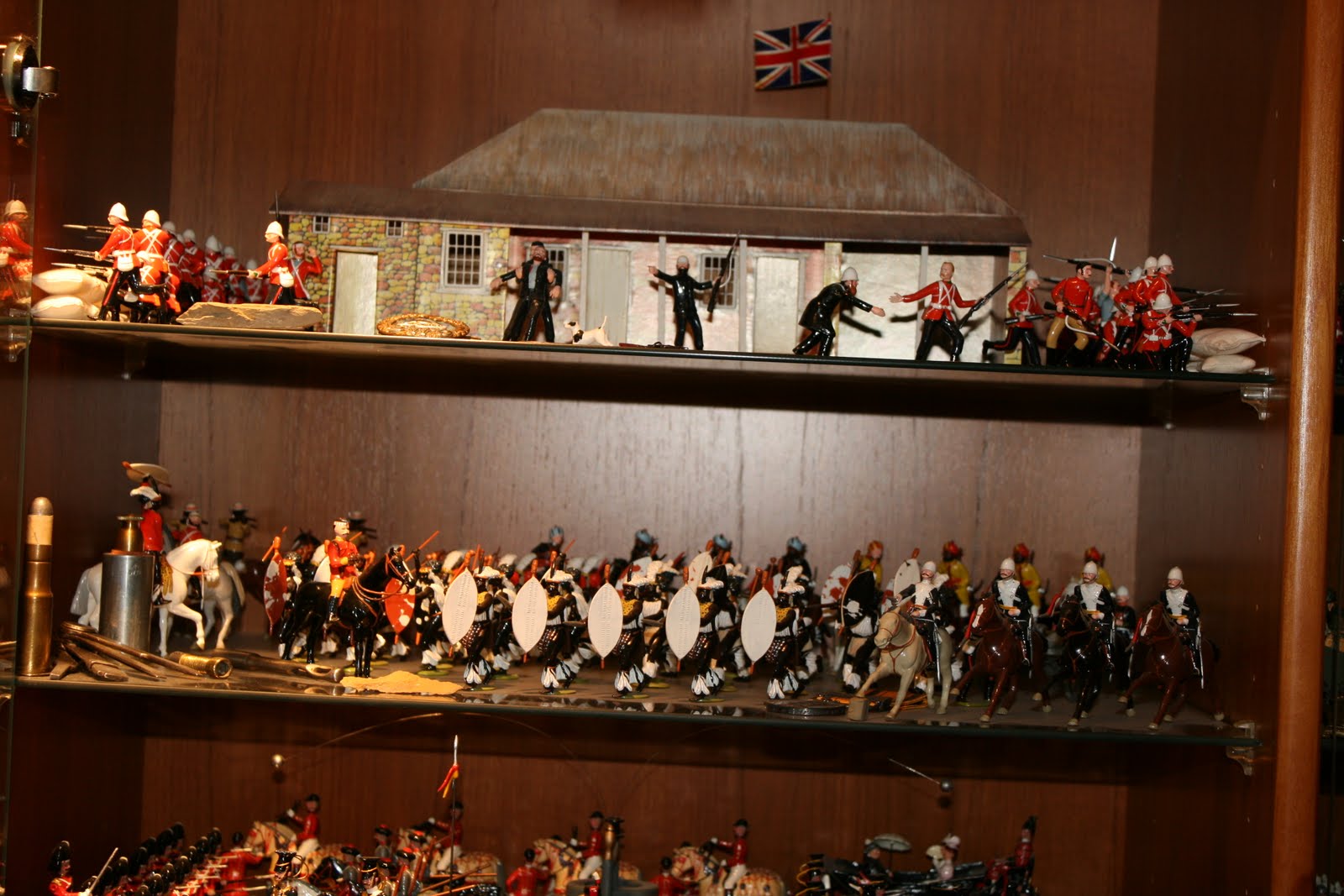
In the following photographs you will see a fairly wide variety of toy soldiers reflecting both famous regiments and the battles they fought, integrated with other items of militaria, including original British Campaign Medals. Those familiar with the style of W. Britains toy soldiers will readily recognize them. Britains collectors will probably also recognize the similarity of Bill Hocker's sets. Other toy soldier and military miniature manufacturers that can be seen include, Greenwood & Ball, Imperial, Steadfast, King & Country, Blenheim, All the Queen's Men, Mark Time, Asset, Rose, Imrie-Risley, Monarch Regalia, Frontline, Toy Army Workshop, St Peterburg Collection, Battlezone, British Bulldog, Chota Sahib, Crescent Toys, Corgi, Tommy Atkins, OZ Made, PNF Figurines. Kingcast, Militia, Soldiers of the Queen, Franklin Mint, Dinky Toys and Forces of Valor.  Please click on any of the images to enlarge them.


As has been told to my grandchildren, with the right kind of care and nurturing in the Arizona climate, the toy soldiers can grow. The following are two good examples.

British Parachute Regiment Officer,
Full Battledress circa 1944

Lieut-Colonel 92nd Gordon Highlanders
Review Order circa 1936

Friday, June 3, 2011

Battle of Arnhem - Two Movies on the Battle

The author of this blog has had published two reviews on movies chronicling the Battle of Arnhem. The first was 'Theirs is the Glory' (1946) and the second 'A Bridge Too Far' (1977). Reproduced below they can also be found at Airborne Assault ParaData, The Living History of the Parachute Regiment and Airborne Forces. See; http://www.paradata.org.uk/content/theirs-glory-1946 and
http://www.paradata.org.uk/content/bridge-too-far-1977.

THEIRS IS THE GLORY

The film 'Theirs Is the Glory', produced in 1946, was the first significant effort to chronicle the gallant stand of the British 1st Airborne Division, including 2 Wings of the Glider Pilot Regiment and the 1st Polish Independent Parachute Brigade Group in the battle of Arnhem (Operation Market Garden) which lasted from 17 September to 25 September 1944. It preceded the epic film A Bridge Too Far by 31 years.

It was a unique production in many respects, not the least of which was it was actually filmed on the war-torn site of the battle, used as ‘actors’ only actual participants in the battle, and was jointly produced by the J. Arthur Rank Organization and the British Army’s Film and Photographic Unit (AFPU). Some of the cast members having been only recently released from POW camps.

Among the persons appearing in the movie were, Lt. Hugh Ashmore, Maj.C.F.H."Freddie" Gough, Maj. Richard "Dickie" Lonsdale, Mrs. Kate ter Horst, Pte Tommy Scullion of County Antrim, Pte Peter Holt from Middlesex, Pte David Parker from Scotland, Cpl Pearce from Wales, Pte George ‘Titch’ Preston from Grimsby, Pte Frank ‘Butch’ Dixon (proven lethal with a PIAT), Sgt John Daley of Waterford, and war correspondents Stanley Maxted and Alan Wood. In addition the total cast was comprised of other paratroopers, gunners, sappers, RAMC, RASC, reconnaissance squadron and the glider pilots, all veterans of the battle. Each member was paid £3.0s.0d. per day by the Rank Organization.

The movie had simultaneous premieres in Ottawa, Arnhem and the Gaumont Theatre in the Haymarket London on the second anniversary of the start of the battle, 17 September 1946.

Originally in VHS format from 1987 and more recently on DVD, it is currently available in European format (PAL) and on NETFLIX. A detailed article on the making of the film was contained in After the Battle Magazine, Issue number 58.


If you would like to watch the movie in its entirety, it can be seen at;
http://www.youtube.com/watch?v=cCgxoaSi1f0

A BRIDGE TOO FAR

The year 1977 saw the release of the movie A Bridge Too Far, which now ranks as one of the epics of World War II. It is based on Cornelius Ryan’s book of the same name, which chronicled the British, American and Polish Airborne Forces, as well as their German foes, during Operation ‘Market-Garden’, 17 September 1944 – 25 September 1944. There is a specific focus on the British 1st Airborne Division and their action during the battles of Arnhem and Oosterbeek. It is one of the last major war movies to be made in Western Europe.
In addition to accurately conveying the overall action, the movie used a series of vignettes portraying significant personages in the battle with a cast of eminent actors. The Hollywood production directed by Sir Richard Attenborough, and produced by Joseph E. Levine, included, Anthony Hopkins, Sean Connery, Michael Caine, Robert Redford, Sir Laurence Oliver, Liv Ullmann, Edward Fox, Gene Hackman, Maximilian Schell, Ryan O'Neal, Dirk Bogarde, Hardy Kruger, Elliott Gould, and Jimmy Caan.
There were several significant technical features in the movie. Included was the hire of a veritable livery of over 100 World War II vehicles and armour from the Military Vehicle Museum, in Falmouth, owned by Charlie Mann. Eight C-47 Dakota troop transport aircraft were on hire from the Finnish and Royal Danish Air Forces. Six full-scale Horsa gliders were constructed. The logistics of feeding, boarding, transportation, wardrobe, armoury, film-making equipment were equivalent to an actual major military operation. The movie was estimated to have been injected in excess of £8 million into the local Dutch economy for hotels, motels, hostels, lodging rooms, suburban homes and caravan parks.
The movie is available in both VHS and DVD format. A detailed article on the making of the film was contained in After the Battle Magazine, Issue number 17.


Monday, May 30, 2011

Battle of Arnhem - Colonel John L. Waddy OBE (Rtd) relates the action of the 156th Parachute Battalion

Then Major (later Colonel) John L. Waddy commanded B Company, 156 Para Bn, 4th Parachute Brigade Group. After retirement he has conducted battlefield tours, and authored a detailed illustrated guide, relating his unique insight of the Battle of Arnhem, based on his direct combat experience. His book entitled, 'A TOUR OF THE ARNHEM BATTLEFIELDS 17 - 26 September 1944', John Waddy,  Leo Cooper, South Yorkshire, 1999, ISBN 0 85052 571 3, is highly recommended. He was a technical adviser during the making of the movie, ‘A Bridge Too Far’ in 1977.

COL John Waddy OBE walking with LTGEN John Gordon
Lorimer DSO, MBE, and Dutch Minister of State for Defense
Mark Francois at the 70th anniversary of Operation Market Garden 

As an integral element of one of his most recent tour/lecture series of 16 April 2011, he was video recorded directly on the former drop zone (DZ 'X') and landing zones (LZ 'Z' and 'S') of Renkum Heath and Reijerscamp, over which he and B Company of the 156th Bn fought, when they landed as an element of the 4th Parachute Brigade Group (delayed by 4 hours due to weather in England) on the second day, 18 September 1944.

 The video provides the rare opportunity of witnessing an oral history by one of the few remaining combat officers who actually served and fought at Arnhem. Below is a copy of a contemporary British Army map of the area (click on map to enlarge, and you may want to print off a copy in order to more easily follow the course of the battle). Colonel Waddy's videos follow and are in sequence of the six part series of his briefing. Colonel Waddy can be seen briefing visitors at the Hartenstein Hotel (Airborne Museum), Oosterbeek, in 1961 at http://www.paradata.org.uk/media/2252?mediaSection=Photos&mediaItem=10169

Below in the first segment of his briefing Colonel Waddy discusses some aspects of the planning for Operation Market-Garden. One of the principal reasons for creating this blog was to share an in-depth analysis of all aspects of that planning. If the viewer is so inclined they can read that analysis by going to the main menu bar and clicking 'Operation Market-Garden'.


Saturday, May 21, 2011

British & Commonwealth Cap Badges - Known Common Restrikes and Counterfeits

In an attempt to provide further assistance to collectors in identifying and differentiating genuine British and Commonwealth Cap Badges, the following list is offered of some of the more common restrikes and outright counterfeits/fakes known to exist. As can be seen Special and Elite Forces predominate. One of the other common groups of badges frequently seen in restrikes are the Scottish Regiments of both the British Army and Commonwealth. Please be aware that this, unfortunately, is just the tip of the iceberg.

The Parachute Regiment (discussed in detail on this site in WWII Parachute Regiment Cap Badge - A Forensic Study)
Special Air Service Regiment
No. 1 Demolition Squadron (Popski's Private Army)
Long Range Desert Group
Raiding Support Regiment (cloth)
The Glider Pilot Regiment
The Army Air Corps
No. 2 Commando (metal and cloth)
The Reconnaissance Corps
The Reconnaissance Corps (Yorkshire Units, w/rose)
101 Troop (6 Commando) (cloth)
V Force
No. 50, 51 and 52 Commando
21st Special Air Service, Artists Rifles
21st Special Air Service, Artists Rifles, (cross belt badge)
Special Boat Service WWII (metal and cloth)
Special Boat Service, Royal Marines (cloth, current) 
Special Reconnaissance Regiment (cloth, current)
Canadian Parachute Corps
1st Canadian Parachute Battalion (cloth)
17th/21st Lancers
19th Hussars
King Edward’s Horse
Canadian Armored Carrier Regiment
Royal Naval Air Service Armoured Car Section (WWI)
Royal Canadian Mounted Police
Gaurds Machine Gun Regiment
Royal Naval Division (WWI 6 badges, see detailed analysis in another page of this blog)
            Anson Battalion
            Hood Battalion
            Howe Battalion
            Drake Battalion
            Hawke Battalion
            Nelson Battalion
75th Regiment of Foot (1874-1881) Glengarry (see blog on Fox & Co. restrikes)
92nd Regiment of Foot (1874-1881) Glengarry (see blog on Fox & Co. restrikes)
92nd Gordon Highlanders (badge attached to shoulder belt plate)

The British and Commonwealth Badge Forum (http://www.britishbadgeforum.com) is one of the best web sites available for assistance in identifying restrikes and counterfeits. Once having joined the forum, using the search word ‘restrike’ you will immediately have at your disposal a database of 500 entries. In order to narrow that down the next obvious search term would be the specific name of the cap badge in question. There are member's specific albums devoted to restrikes and counterfeits. Most importantly, while only the front (obverse) of example badges are shown here, the albums show the backs (reverse) which are critical to accurate identification as well. Courtesy of various members of the forum here are a few examples of reproductions (Click on individual images to enlarge).
WWI Royal Naval Division
(Nelson Battalion)
WWI Royal Naval Division
(Anson Battalion)
WWII Reconnaissance Regiment
(Yorkshire Units)
WWII V Force
WWII Intelligence Corps
In addition the following individual, listed as kao751, has developed and published 7 guides on e-Bay which are very detailed and quite helpful. This is both a significant and excellent piece of research.


One of the members of the British and Commonwealth Badge Forum has recovered and published a list of known reproduction Canadian Badges circa 1989. There is some redundancy with the previous list.

Prince Rupert MG (2 piece)
Osgoode Hall COTC
CWTS Red Cross
Knights of Columbus
U of McGill COTC
Prince Edward Island Light Horse
Newfoundland Regiment
Toronto Scottish (small officers version nickel silver)
General List (Maple leaf with GL over beaver)
British Columbia Women’s Auto Assoc
British Columbia Regiment
Irish Regt of Canada kc (bimetal officers base, large size like qc)
RCAF (brass)
RCAF (bandsman in sterling silver)
8th Recce (sterling with white gold overlay)
Maple Leaf 2nd Canadian Special Infantry Battalion Aldershot
RC Air Cadets (badge used for overseas cadets)
NB Regt Tank
Canadian Armoured Carrier Regiment
2nd Armd Car
Canadian Parachute Corps
Manitoba Volunteer Reserve
Control Commission Germany (sic)
P.E. Instructor (sic)
15th Light Horse
16/22nd Sask Horse (gilt officers)
Brigadier General
RCA Veterinary Corps (two piece sterling overlay)
Manitoba Mounted Rifles
Alberta Officer Training Corps (??)
CATS (Can Aux Trans Service)
CMHQ maple leaf badge (sterling silver)
Special Service Force (arrows)
Jr Soldier (Salvation army)
Garrison Regt
Trinity College COTC
De La Salle Cadets 247
Toronto Public School Cadets
Bishop Ridley College (cadets)
Veteran’s Brigade
RC Navy CPO kc two piece with sterling anchor
Maple Leaf with three C’s. (corps of commissionaires)
Cadre Instructor
McMaster U COTC (sterling)
Boys Brigade
Regiment de Lévis (small shield)
RCAF busby badge
Argyll and Sutherland Highlanders Military School of Piping
Seaforth Cadets
Piper’s arm badge
48th Highlanders TRH
48th Highlanders YTC
Seaforth Highlanders 4 piece officer’s sterling
Mount St Louis COTC
Newfoundland Highlanders
Newfoundland Pipe Band
Winnipeg Highland Cadets
20 EFTS
Ashbury College Cadet Corps
Prince of Wales Rangers
Boys Brigade (large pattern in sterling)
Brigadier General (large and small in bronze)
RCA Chaplain Corps collars
RCA Chaplain Corps gold plate with sterling overlay
Galt Aircraft School
King’s Own Rifles Corps
Canadian Women’s Volunteer Reserve
Irish Regt kc sporran
Oxford Rifles
Argyll Tank
Argyll Light Infantry
Halifax Cadets
La Salle Cadets sterling over gold
CWAC base badge
Sask Vets Civil Service (sic)
Canadian Corps Commissionaires 1st type scroll on bottom
Middlesex Regt(qvc crown on kc pattern badge)
Canadian Women’s Service Force (maple leaf pattern)
UCC kc
RCAF Association hand painted
2nd / 10th Dragoons
Cape Breton Highlanders (Canada on top)
Regiment de Québec
Pictou Regt 2 piece sporran badge
Defence Research
Victoria Rifles of Canada
Royal Canadian Ordnance Corps
Canadian Guards Bandsman
Chaplain’s Badge
Tri-service badge 57mm pattern
UCC qc
Irish Regiment qc sporran
Regina Rifles qc 10 battle honours error
9 Bn CEF
BC Horse shoulder titles
31 B C Horse collars
31 B C Horse cap

Given just these lists, as a collector you begin to appreciate not just the need for, but absolute necessity of acquiring a reference library. Because you are dealing with detailed features in every case, the requirement for clear photographs of genuine examples is inherent in the criteria for that library. Conversely photographs of the details of identified fraudulent badges can also be helpful in your forensic analysis, and believe me it has truly become an application of forensic science.  Recommendations on some of the acknowledged excellent references are discussed in this blog under 'British Militaria'.