Saturday, June 8, 2019

Addendum to Officers of The Glider Pilot Regiment - circa 1944

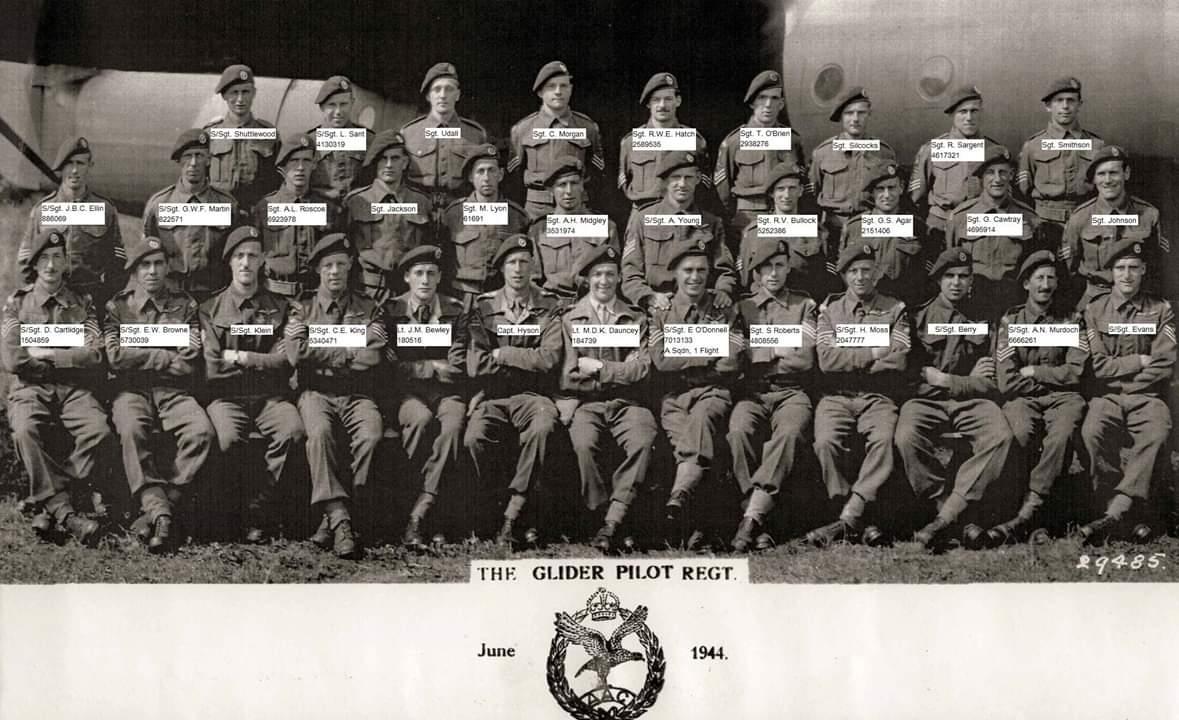
Given the occasion of the 75thAnniversary of D-Day Operation Overlord, this author thought it highly appropriate to present a pair of photographs which have recently come into my possession. They have been graciously contributed by a lady in Great Britain who happened to read one of this blog’s articles on the WWII Glider Pilot Regiment of the British Army, specifically; http://arnhemjim.blogspot.com/2013/08/the-officers-of-glider-pilot-regiment.html As followers of this blog already know this author has had a protracted interest in the regiment, not only because of its significant participation in Operation Market Garden, but of its critical and highly successful operations during D-Day. Those who are familiar in detail will be able to tell you that among others the actions capturing the Orne Canal (“Pegasus”) Bridge and the Merville Batteries were absolutely essential in achieving the success of the invasion. Both are official battle honours awarded to the Glider Pilot Regiment.

The ladies’ name is Ms. Gema Young, and her grandfather was S/Sgt Alexander Young. Examination of the black and white photograph shows him apparently wearing the wings of a qualified First Glider Pilot. This author wishes to express both sincere gratitude and acknowledgment for her permission to share the photographs with the readers of this blog. She certainly deserves to be extremely proud of her grandfather. Research has established that S/Sgt Young was in then Lt M.D.K. Duancy’s (later Brigadier Michael D.K. Dauncey DSO DL) section of “G” Squadron 9 Flight of the Glider Pilot Regiment that delivered the elements of the 1st Airlanding Brigade of the 1st Airborne Division on to the landing zone LZs “S”, and “Z” at Arnhem. This narrows it down to his having piloted one of the following 12 Horsa Chalk No. (individual gliders) in the first lift; 506, 508, 509, 510, 511, 512, 513, 514, 515, 517, or 516 and 517 (both initially aborted from the first lift and flew in the second lift). He survived the battle of Arnhem and the Oosterbeek perimeter, and was successfully evacuated to Nijmegen on 25/26 September 1944. Knowing that S/Sgt Young fought in, and survived the Battle of Arnhem, would establish the extremely high probability that he also had already participated in the Glider Pilot Regiment’s actions on D-Day (double click to enlarge either image).


 Dating the photograph of the entire regiment, in which S/Sgt Young also appears (4thfrom left in 3rdRow) is a bit of a challenge, but has to be fairly early in the history of the regiment. Most significant is the fact that there are only fifteen officers shown in the photograph. Compare that number to the photograph taken in mid 1944, shown in the other article. The official formation of the Glider Pilot Regiment with effect from 24 February 1942, was published in Army Order 128/1942.  Given the wearing of the maroon beret, the photo had to have been taken after 29 July 1942, when it was first officially authorized and initially issued. Obviously the RAF Group Captain in the center of the first row is not LCol John Frank Rock, first Commanding Officer of the regiment, or then Maj George James Stewart Chatterton, who had assumed command after the unfortunate death of LCol Rock (27 September 1942). It may be RAF Group Captain L.G. Harvey, but the resolution precludes positive identification, and the face doesn't seem to bear an immediate resemblance. Further information regarding the exact date of the photograph would be greatly appreciated by the author.


The author would also like to acknowledge the monumental research effort of  authors Mike Peters and Luuk Buist, the results of which are documented in their book, GLIDER PILOTS AT ARNHEM, Pen & Sword Military Books, Barnsley, South Yorkshire, 2009, ISBN 978 1 84415 763 1. Without their work none of the information about S/Sgt Young at Arnhem would be in this article. 

Sunday, May 26, 2019

A Semi-Forensic Analysis of the WWII British Army Air Corps Badge

A query by a gentleman named Frank from the Netherlands has prompted the subject of this article. Unfortunately, the World War II British Army Air Corps cap badge has been the target of counterfeiters almost as frequently as the Parachute Regiment cap badge. The Army Air Corps was formed in February of 1942, and was comprised of the Glider Pilot Regiment (GPR) and the Parachute Regiment, both wearing the same cap badge until the Parachute Regiment received its own in May of 1943. Following that date, the badge was only worn by the Glider Pilot Regiment through to the conclusion of WWII. Technically as of April of 1944, the Special Air Service (SAS) was attached to the Corps, but continued to wear their then well-established winged dagger cap badge.

The basic badge is of white metal, and comprised of a circular laurel wreath with a right facing eagle superimposed and clutching two semi-circular bars attached at the base of the wreath containing the plain (no serifs) three block letters, A.A.C At the top is the standard imperial King’s Crown (K.C.). It was conventionally die-struck with lugs. There is a continuing controversy as to a genuine variant using a slider. 

The author was presented with a slider variant in white metal by a retired major, who had served in the GPR during the latter stages of WWII, with an accompanying letter specifically stating in part, “Enclosed is a Glider Pilot Regiment cap badge. It is a genuine wartime one, not a later re-strike.” It was not his personal badge but a standard one issued to other ranks. It features include (double click to enlarge images); 
- A slider not lugs
- A slightly blunted, not pointedly sharp eagle’s beak
- A voided K.C. with well defined detail
- Clean reverse die strike
- Sharp well-defined tips on laurel wreath leaves
- Non-voided letters in “A.A.C”, two periods very well defined
- Clean definition of letters from bars
- Laurel leaf barely touching, not overlapping third feather from bottom of right (left as viewed from front) wing
- Extremely well-defined legs and claws (talons)
- Slightly duller overall appearance indicative of white metal


As inferred from above the following badge features should be carefully inspected;
Lugs not slider preferred unless additional provenance available
Definition of eagle’s beak and claws(talons), in this case the flawed (blunted) eagle’s head and beak indicates higher probability of genuine badge. Also note flaw in tip of laurel leaf.


Laurel wreath leaves on left side extending over eagle’s wing feathers
Non-Voided letters (A.A.C) versus Voided (non-voided preferred)
Well defined cross on top of crown
Clean, well defined die strike particularly as viewed from reverse of badge
Sharp leave tips on laurel wreath

In addition to the basic badge the following legitimate variants are known to exist. Starting with the basic white metal badge issued to other ranks I will hopefully show in sequence an image of a genuine example of each (front, and reverse when available).

Basic badge, die struck in white metal


Die cast, not struck, in gilding metal with 3 lugs


Solid silver, hallmarked with three lugs (Officer’s)


Silver plated (Officer’s)


Cast bronze (allegedly genuine with rather crude casting of eagle’s head, sharp beak, and 3 lugs, also note overall crude lack of definition)


Economy issue in bakalite


Silver embroidered bullion wire on maroon backing (Officers)


The metallurgy of white metal is (64,5% Copper, 16,5% Zinc, 19,0% Nickel by weight, Royal Army Clothing Department Pattern No. 4481/1897) with brass lugs.Gilding metal is very similar (86,7% Copper, 13,3% Zinc), with brass being (67% Copper and 33% Zinc).

Subsequent to the end of WWII the Glider Pilot Regiment cap badge was revised. The new features included reversing the position of the eagle, changing it from facing right to facing left, replacing the wreath with a three-fold finely pebbled scroll containing the serifed lettered words, GLIDER PILOT REGIMENT. It was further modified in 1957 with the replacement of the King’s Crown with a Queen’s Crown for Queen Elizabeth II.


Sunday, May 5, 2019

A 21st Century Technology Against Badge Counterfeiters

More and more frequently both historical and current elite unit badges and insignia, as well as rare historical badges  are being counterfeited and appearing on the military badge collectors market, realizing exorbitant prices, hundreds of dollars/pounds having literally gravitated into the thousands. This fact is being exacerbated by the fact that previously highly reputable dealers and militaria auction houses are experiencing having their “experts” fooled by the quality being achieved in the fraudulent badges, or have allowed their past diligent venting standards diminish, or a combination of both factors. These facts have resulted in a significant frustration level permeating the entire collector population, and in the extreme case people, ceasing to add to their collection, or divesting and leaving the hobby altogether. In either instant this is not only detrimental to the overall hobby, but to the continued livelihood of the dealers and auction houses.

The use of scanning electron microscope (SEM) technology as “one tool” in forensically evaluating authenticity of badges has been recognized for some time. Until recently the invasive specimen selection process (apparently now eliminated), combined with the high price of the capital equipment, $0.5mil USD to $1.0mil USD and a trained microscope specialist, has virtually precluded the practical development and application of this technology in a broad, cheap, definitive, and convenient forensic method. In addition, by no means does it provide a definitive comprehensive verification What it does supply is a significant additional investigative tool.

In a very recent post on the British and Commonwealth Military Badge Collector’s Forum, a member, Wayne Logus, has presented a “proof of concept” for this truly forensic analysis technology which assists in determining whether a metal cap badge is genuine or counterfeit. With full acknowledgement of his effort, and expression of gratitude for his kind permission, the results of his study are herein presented.

“Can Science help distinguish replica, metal-made collectables?
Apologies for the long post.
I would like to present to fellow collectors, an experiment I undertook at our local university this week. The purpose was two-fold; 1) to establish a “proof-of-concept” for using SEM-EDX to adequately identify the elemental composition of a collectable, metal insignia and, 2) to use this same technique to try to determine that, if by looking at the elemental composition, one might be able to determine replica or “fake” items within the vast field of collectables. To demonstrate the later, I choose to look at one of my collecting interests, the CAF (Canadian Air Force) insignia circa 1920-1924. They are uncommon enough that one generally doesn’t come across a large selection so collectors may only see these in isolation at shows, dealer’s stores, online or auction houses and at times, it can be very difficult to know if an item is truly an authentic, original, period piece or not. As we all know, it’s getting harder as the fakes and fakers get better.

The Zeiss-EVO SEM-EDX (Scanning Electron Microscope with Energy Dispersive X-ray) is an instrument which, beyond incredible imaging capabilities, allows materials research and analysis which can provide quantitative*, elemental identification. In my case, I was primarily interested in the later for my insignia not the imaging capabilities so coating of the samples wasn’t required and the technique is non-destructive; i.e., you get your stuff back intact and unaltered! The scientist who ran this instrument during my session was very knowledgeable, helpful and pro-active with suggestions (thanks Nathan).


Over the last few years, I have picked up several examples of the enlisted, Type 2 (with motto) versions of CAF collars which have had an unexpected crown for the issue. Unusual in the sense that it has the larger void shape normally reserved for Officer’s more complex, multi-component badges. Enlisted versions have a small void in the crown and are basically two-piece; a CAF monogram fitted over a die stamped body and fastened in place by a pin through the center then riveted to the back of the badge. Could there have been errors during assembly, some variant that hadn’t been reported or were they modern replicas?
The first two images below illustrate an original collar on the left and the questionable copy on the right. I’ve highlighted a few differences to note between the two. The lack of detail on the reverse of the replica is a give-away – if you know what to expect. Four additional variations are shown, each with a slightly different finish but by using the SEM-EDX, they show a wide variety of elemental compositions. The top left example is very interesting as it is mainly an alloy of tin with some lead. The finish is from an aluminum powder coating or paint and there is a high percentage of Cd, Cadmium in the piece, a toxic compound often found in off-shore costume jewelry. The top right example is basically made from a 50/50 solder of Pb-Sn (lead-tin) composition.


The original enlisted versions of cap and collar CAF insignia have an elemental composition of primarily Copper, Nickle and Zinc often called “German” metal. Based on initial measurements of several period pieces of CAF cap and collars, they all exhibit similar ratios in their major elemental components.
To illustrate the EVO’s output, a rough graph and semi-normalized elemental weight% values of one replica piece is illustrated. Further calculations and assumptions to normalize all readings were required to give a final “quantitative” estimate of the various elements present. The microscope doesn’t analyze the entire badge; only a very small, sub mm portion selected by the user and chosen to be representative of the object under study. The area is selected to be “clean” from surface contaminants; oxidation, sulfonation, the initial organic lacquer applied to these insignia to help preserve luster, grease and dirt, etc.


One of many interesting side observations that came out of this study was that at least some original enlisted CAF monograms had a trace of surface silver plating presumably to highlight that component. The low res SEM image shows the valleys and ridges on the top of the “A” in the CAF monogram. Visually through the SEM eye, one can observe a difference in the composition as demonstrated by a shade and texture variation and further borne out in the analysis at the points of the barely visible, green, overlaid numbers 2 and 3. The lower recessed layer contained regions indicated at over 95% silver while the majority of the monogram was the same composition as the main insignia. This suggests a very light silver coating on the NCO monograms which has worn off on the higher relief regions; more sampling of different pieces would be required to confirm this as a general statement. Also noted in passing is that the monogram pin is composed of 100% copper, probably because it was easy to solder onto the monogram and easy to rivet to the body of the badge.
I was also able to briefly look at some replica CAF pilots wings (I have four, clearly different replica variations but all possibly formed from the exact same duplicated die). This will be discussed perhaps in a submission to the MCCoC Journal down the road.


Other collectable areas such as fine art, stamps and sports memorabilia have respected recognized experts, technology and organizations where one can send their rare and valuable items for authentication and certification. Perhaps it’s time our field offered such a service too? Maybe this instrument will play a role in that in the future.

Regards,
Wayne Logus”

Wayne has well defined what this level of forensic analysis can do, however there are limitations to what scope and extent of proof it can and cannot provide. Here are some of the limits;
The repeatability, i.e. consistency, of the readings on multiple samples taken from different locations on the rear of the same badge were shown to be at or around the 95% level.
The size of the samples achieved to date are well below the size required for that required for a mathematically established statistical sample.
The variability of the metallurgical composition between production runs by a single manufacturer over time, or between different manufacturers has not been established.
Wayne has cited the cost at around $65.00/hour with the ability to analyze six badges in the span of an hour. So, a collector must make a cost effectiveness decision on the expenditure.

As was previously stated the methodology provides an additional weapon in the arsenal against counterfeiters. Combined with the other weapons in that arsenal it provides an additional element of defense for collectors. It would be much to their credit if on particularly high-end rare/unique items, dealers and auction houses would incur the expense and include an analysis certificate with the item.
Saturday, April 27, 2019

An Addendum and Update on the State of Toy Soldier Collecting

This author personally believes that a significant evolution has occurred in the collecting of toy soldiers. As has been previously and frequently stated in this blog at least two major factors have been driving the collection of toy soldiers/military miniatures for at least several decades. I personally feel that for the serious collector, regardless of their resources or perspective of interest, there has been an evolution from the classic toy soldier to the military miniature, i.e. from vintage Minot and W. Britains Ltd to King & Country, Thomas Gunn and John Jenkins, just as examples. Strongly illustrative of this trend is the decrease of auctions of vintage toy soldiers (W. Britains) in both the United States and Great Britain, and the overall diminished presence and quality of the sets being offered on e-Bay. Further corroborating this fact is the significant overall decrease of prices realized at auction in recent years, again with exceptions. If one views recent photographs at the decreasing number of remaining toy soldier shows (West Coaster and Texas are gone, and in the U.K. the shows are much smaller) the discernible absence of the iconic shiny red W. Britains boxes is consistent. The notable exceptions (there are always exceptions) being William Hocker and Imperial (New Zealand). Hocker more so than Imperial, providing a nostalgic bridge to the past, including the shiny red boxes.


My personal opinion is that the increase in scale, 1:32 (54mm) to 1:30 (~60mm), and the resultant significant increase in detail, quality of figure sculpture and painting (and in most cases historical accuracy), and the predomination of matte over gloss finish, have been the principal results. Obviously as this has occurred, and with the overall world skilled labour market, prices have sharply increased in recent years. I can clearly recall a previous parallel example. In the late 1940's to the mid 50's a box/set (8 infantry or 5 cavalry) of W. Britains Ltd. cost between $1.25 to $2.00 USD, but even then, a single Greenwood & Ball figure was priced from $6.50 to $9.50 USD, at the time at least for me, an exorbitant cost. 

The second factor of this evolution being the trend from merely display of mass formations to dioramas, has caused a change in the resultant facets of judgement and appreciation of individual collections.  And again Malcom Forbes presentation format at his museum in Tangiers, Morocco and Anne Brown’s collection at the Brown University Library (see; https://library.brown.edu/collections/askb/) being significant exceptions.


The following is a photograph of the late Ed Ruby with a portion of his collection (in the previously classic format), considered by many, including James Opie, to be one of the world's consummate collectors of vintage W. Britains Ltd. toy soldiers. It is followed by two images of a portion of the author's collection.  The first being in the older traditional format, and the second in an attempt at a semi-diorama format.


Until recently dioramas were predominately the domain of museums. Once again, the exceptions being individual “objects de art” and/or vignettes. Here artists in the Russian Federation, such as Aeroart of St. Petersburg and Attica Miniatures would appear to currently predominate the field, as seen in the following images. It is extremely difficult to comprehend that these amazing figures are 1:32 (54mm) scale.


Not unlike the media of more classic and conventional art (with the obvious exception of modern abstract art) and photography, the elements of composition, historical accuracy, visual effects, and unique subject matter/backgrounds are significant factors. In this author’s opinion this tends to relegate the figures to merely an element, albeit essential, of the artist’s palette/lens.


All that having been said there is absolutely nothing to be taken, inferred, or intended of a negative or derogatory nature by the discussion of this evolution, it is that, an evolution, which should be both recognized and appreciated. However, there is one disconcerting element in addition to the sharp price increases that is universal, and the decreased collector population at the shows, that being the almost absolute absence of younger aged collectors joining the ranks. Unfortunately this is entirely understandable (given the prices) with the exception being the millennials, where apparently there is a lack of interest for one reason or another.


There is a saying sometimes uttered to categorize collectors , that is "there are the out-patients and there are the committables". For those who might be of the latter category, the following three videos are from the twice yearly London Toy Soldier Show of 2018, and should at least partially appease you cravings. Apologies for the limited redundancy. This is one of the few remaining shows in the world where there still is a significant representation of the classic vintage W. Britains Ltd. toy soldiers (1893-1966), along with the firm's current production line.


Monday, February 25, 2019

Royal Naval Air Service Armoured Car Section/Division Collar Badge - A Semi-Forensic Analysis

Paralleling the popularity of collecting the six battalion cap badges of the World War I Royal Naval Division is collecting the affiliated insignia of the Royal Naval Air Service Armoured Car Section, which was soon expanded into a Division. This principally consists of the collar badge (“dog”), with limited variants, which are frequently mistaken and referred to as a cap badge.

As is the case with the battalion cap badges, the collar dogs have provided fertile ground for unscrupulous entrepreneurs to exploit the demand provided by beginning, as well as even advanced collectors, who have not conducted in-depth research or obtained specimens with impeccable provenance.

In assessing the authenticity of a genuine collar dog look for the following details.
• In the copy the letter “R” in RNAS is very close, if not almost touching the left hand edge of the armored car’s turret. In the originals there is a space.
• In the copy the dimpling on the front surface area of the badge is very pronounced, if not almost rough. In the originals this surface is smoother to both the touch and appearance.
• On the originals the lugs are consistently spaced, directly above the wheels and level with the top of car’s body.
• Of the originals there are apparently two types, one with voided crown, one non-voided crown, with a slight variance in size and weight:
Voided 49.32mm x 40.48mm and 52.85 g
Non voided 48.38mm x 41.72mm and 53.05 g
A smaller size original also exists with a variance in dimensions:
One being 25mm wide x 30mm tall.
The other cited as an o/r collar, being 17.07mm x 30.55mm.
 • Depending on the manufacturer’s dies there is another variance in the originals of two types; termed by some collectors as a 'Low' bonnet & tray and a 'High' bonnet & tray. As best determined this refers to the depth and curvature shown on the reverse side. Copies tend to have the high characteristic. 
• Copies tend to have thin/skinny lettering, and poor definition in the crown and jewel detail.
• Originals all have lugs, not sliders.
• Originals have a rich dark matte finish in a range of shades, but certainly not a shiny or brassy appearance.   

Again, as is typically the case, best assurance is well established provenance.

The following three badges are classic counterfeits, because of several of the above cited details.


Based upon the same set of authenticating criteria the following badges have a high probability of being original and genuine.


The following badge is a known genuine variant, probable officer's collar dog.


The following image not only shows the badges being wore, but it also shows the man on the left wearing the distinctive ammunition pouch issued with the Webley Scott .455cal. Self-loading Pistol MkI Model 1912. Note the absence of the set of cartridge loops on the flap and the squarer shape of the pouch compared with the man on the right. See; http://arnhemjim.blogspot.com/2016/05/tell-it-to-marines.html for details.


Another image showing a group of officers of the R.N.A.S. Armoured Car Section/Division wearing both types of collar insignia.