Monday, May 16, 2016

Critical Resupply Shortfall during Operation Market-Garden - Arnhem 1944

It is debatable as to what effect on the overall outcome of the battle it would have had, but to the best of my knowledge, contingency planning for the resupply of the British 1st Airborne Division once on the ground at Arnhem and Oosterbeek, was severely lacking. By that I mean revision and reconfiguration of the supply drop scheduling, navigational coordinates, and drop contents, due to actual troop positions/situations as the battle evolved, and the requisite communications plans necessary to affect those changes. Documented planning considerations did include alternative dropping and landing zones being selected beforehand (whether they were or not is unknown to the author), but no such provisions for resupply. A principal reason for this is that the doctrine and planning for the employment of airborne troops at that time, was that they were "intended to fight not more than three days unsupported by other troops". Note the paucity of guidance regarding resupply in the totality of planning documentation found in; http://arnhemjim.blogspot.com/p/operation-market-garden.html.

There is an excellent book, “ARNHEM THE FIGHT TO SUSTAIN”, The Untold Story of the Airborne Logisticians, Brig. F. Steer (ROC- Rtd.), Leo Cooper, South Yorkshire, 2000, ISBN 0 85052 770 8, which covers virtually every aspect of logistics, before and during Operation Market-Garden. It relates how many aspects of resupply were considered. It does not however include any mention of provisions being made for the dynamics of the evolving battle, and the resultant effects on changing logistical requirements and revised routing (navigational coordinates) of resupply aircraft sorties.

The following tables, reproduced with acknowledgment and gratitude to Brig. Steer's book, provide a summary of the results of this critical element of the planning:


In his after-action report MGEN R.E. ‘Roy’ Urquhart relates,” We had tried to get messages back by every means to prevent the airmen from dropping their loads in the scheduled places which were in German hands. We had sent co-ordinates of the places they should try to put the stuff down. Hopefully, as the Dakotas came on, we watched for the the first sign that that the pilots were aware, by order or by observation, of the situation. Again, the ground signals were laid and lit, and the troops held out parachute silks. But the aircraft kept to the planned dropping points and the Germans again found themselves receiving gifts from their enemies. Only the overs reached us. Some crews, overshooting, came round in the face of most appalling flak. Some aircraft were on fire. Hundreds of us saw one man in the doorway of a blazing Dakota refusing to release a pannier until he had found the exact spot, though the machine was a flaming torch now and he had no hope of escape.”

Rather than rely only on pre-planned resupply drop co-ordinates and schedules, and solely radio communications to convey requests for any modifications, additional alternative means of communication should have been incorporated into the communications and resupply annexes to the Divisional Operation Order. To the best of the author’s knowledge this was not done. The resupply aircraft were delivering the CLE canisters and panniers at a 1000-foot altitude. Visual signaling devices could certainly have been pre-arranged and employed. These could have included; Very pistols, colored flares, smoke candles and grenades (in pre-designated colors or combinations), issued yellow Celanese and/or white marking panels, even the signal lights employed by the pathfinders of the XXI Independent Parachute Company.

The next group of photographs were taken in the immediate vicinity of the Hartenstein Hotel in Oosterbeek, which can be seen in the second photograph.


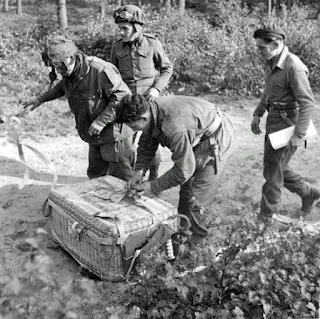


As it was, many of these devices were employed, and as can be seen in the above photographs  extensive improvisation of various means of visual communications were employed, but under no known structured plan. The result was a very high casualty rate amongst the RAF resupply aircraft and personnel (309 aircrew and 79 Air Dispatchers were killed and 107 aircraft lost), lack of adjusted structure and priorities to deliveries beyond initial planning, significant personnel and material casualties on the ground in attempting to retrieve containers, and the bottom line being a totally unacceptable low percentage of supplies recovered. Ground casualties were particularly heavy within personnel of the 250th (Airborne) Light Composite Company of the Royal Army Service Corps, which had a primary assignment of retrieving the air dropped supplies, and establishing/maintaining the Divisional Administrative Area (DAA). This overall situation resulted in a critical lack of basic rations, and perhaps even more importantly, ammunition for all weaponry, from 17 pdr to75mm, all the way down to .303cal. and 9mm. The total amount of supplies reported to have been retrieved was 106 tons (with as much as a possible additional 100 tons not officially confirmed and recorded), 7.4% of what was dropped during the entire operation. See the following table, again with acknowledgement and gratitude to Brig. Steer's book:


If interested, the reader can scroll down in the following blog page; http://arnhemjim.blogspot.com/2012/10/the-polsten-20mm-gun-at-operation.html , and they will find a particularly poignant and tragic true story regarding the resupply at the Battle of Arnhem. It is complete with a copy of the actual War Diary page from the 1st Airborne Reconnaissance Squadron, Royal Ordnance Corps, which establishes its veracity.

Monday, March 14, 2016

Recovery of a Gun from the Land of the Rising Sun


In the late summer of 1978 I had returned with my family from our Honeywell sister facility in Ballard, Washington (Seattle area) after having worked that summer on one of several “black” programs we were engaged in during that time frame. One morning received a call from a neighbor that our home had been burglarized, and the local police were at the premises investigating. We lived in a quiet middle-class area, but certainly nothing of a pretentious upscale character that would be a magnet for crime. The current mayor, a former mayor, and the Superintendent of the Public School District, also lived in the immediate area. That, and the fact that the area was in close proximity to a major north-south street, as well as freeway rams to California Interstate 10 (quick on-off access for burglars), had probably prompted the burglary, and also triggered a reasonably fast police response.

Among the stolen items was a small collection of hand guns. It was before I had the resources to have both a safe and a remotely monitored alarm system, although a small local alarm system was in operation, and we had a Wire-haired Fox Terrier (hearing impaired). The burglars, believed to have been two young men and a young woman, were not on the premises for more than 10 minutes maximum, so only a safe would have been effective.

Suffices a detailed police report and insurance claim were submitted, including the serial numbers of all the hand guns which had been stolen.  At that point I recorded those numbers on a small card, which I carry to this day in my wallet, along with my current Arizona State Concealed Weapons Permit. Try getting one of those even then, let alone today, in California.

Japanese paratroops employing the Nambu Type 14 pistol
during the Battle of Palembang, Dutch East Indies 1942

A particularly bitter loss was a Japanese 8mm Nambu Type 14 (1925) semi-automatic pistol, complete with original leather holster and all major accessories. The year group was 4.2 (1929), manufactured at the Tokyo Arsenal, “Kokura” logo, with all matching serial numbers, including the nickel-plated magazine. Nambu collectors will obviously appreciate that fact. It had been a WWII bring-back, complete with the U.S. Army war trophy registration/authorization paper (provenance), and was a gift from my father-in-law.


A few months passed and one Saturday I was attending the Orange County Gun Show, at the Fairgrounds in Costa Mesa, California. One of the stolen guns I was trying to replace (to the extent I could) was the Nambu pistol. I certainly was not a professionally trained criminal investigator, but am reasonably observant. Subsequently commanded a Naval Reserve Intelligence Unit in direct support of the San Diego Regional Office of the U.S. Naval Investigative Service, forerunner to NCIS of current television fame.

As I passed rows of tables I noticed a Type 14 Nambu displayed for sale with a large group of other hand guns. An immediate sense of recognition occurred. Obviously trying to keep both my voice and hand from any discernable shaking I asked if I might look at the weapon. Carefully turning the gun over I observed all the markings matching my stolen weapon! As slowly as possible I replaced the weapon on the table, thanked the “gentleman”, and immediately started looking for the nearest uniformed Orange County Deputy Sheriff. At that time I was still carrying a copy of the stolen property report that had been filed with the Ontario Police Department. I showed the deputy the report specifically pointing out the entry on the Nambu pistol and its serial number.


With this information now in the hands of the deputy, we returned to the table confronting the seller, and verified the details of the pistol. Unfortunately, in an attempt to obfuscate the original gun some one had swapped out the barrel assembly, consequently a different serial number (821) on that piece, versus the receiver (587). Although now mismatched (significantly decreasing the value of the gun), all the other serial numbers still matched the receiver. (Editorial Note: If by any extremely remote possibility anyone who might be reading this article, and has a Nambu with the same numbers on opposite parts, you could by making the swap, significantly increase the value of both pistols!). 

Obtaining and recording the “gentlemen’s” driver’s license data, the deputy advised him that he was under suspicion of being in receipt of stolen property, and attempting to sell same, but surprisingly did not confiscate the gun, nor place him under arrest. Needless to say this fact “annoyed me quite a bit” (gross understatement). As I can best recall there was a requirement in California law that confirmation of stolen property had to be obtained from the agency holding the original burglary report, by the recovering law enforcement agency.

Fortunately everything turned out alright. I received a phone call the very next week from a Detective of the Ontario Police Department, saying that he had travelled to the “gentlemen’s” residence somewhere in Orange County, and physically taken possession of the pistol. He asked if I would be at home for the next hour, in order that he could personally return the Nambu. Perhaps living virtually next door to the city’s mayor may have helped, as even then gun control laws had begun to complicate lawful ownership/possession in the State of California. Try to get a response like that today, particularly in the State of California. In any event it suffices to say that I consider myself to be an extremely fortunate individual, with a rather unique tale to tell.


The detective advised that from the original theft at our home, the gun had passed through at least two other parties, one of whom was a particularly crass and obnoxious individual who I had already met at that same gun show during the course of the initial investigation. Apparently the initial "fence" had been a photographer in the North Hollywood area. I never found out as to the final results of the total investigation.

One of the most incredulous elements of the story, claimed by the seller at the gun show, was that the gun was an entirely different weapon just happening to have the same serial number. This apparently in the face of the fact that as Nambu collectors know, the "4.2" establishes both the year and month of original manufacture, and the "Kokura" marking, the place of manufacture. Two guns, same place of manufacture, same year and month, same serial number?! According to best established records there were only 535 Nambu Type 14 pistols manufactured at the Kokura Arsenal in February of 1929.

Subsequently, as you can see from the photographs, the accessories were replaced including; an original early Type II leather clamshell holster, w/shoulder strap, original spare nickel magazine, original early type nickel takedown tool, 3 original rounds of ammunition, 2 original spare firing pins and a museum quality repro lanyard. These items were already becoming difficult to find, and becoming expensive. Even then an original lanyard was going for over $150.00 USD.


For anyone who either may also have an 8mm Nambu Type 14 semi-automatic pistol and/or would like to acquire further information, the following website is an excellent source;  Nambu World: Teri's WWII Japanese Hangun Website. Of particular coincidence is that the website contains a detailed illustrated discussion of a Nambu Type 14 from the identical arsenal/year/month of manufacture. For direct comparison here are two photographs of that weapon, with both acknowledgement and gratitude to Teri's Nambu Website.


In addition the following is a short film on the operation of the weapon;


For those fortunate enough to own an 8mm Nambu Type 14, or just may be interested, the following video contains detailed instructions on the field stripping of the weapon; https://www.youtube.com/watch?v=AonJpWAqowQ.


Friday, February 12, 2016

List of Posts on the Arnhem Jim Blog Published as of February 2016


For the convenience of both new and long-time readers of the Arnhem Jim Blog the following list has been compiled. The reader may click on any of the titles of particular interest in order to go directly to the article.

GENERAL

OPERATION MARKET-GARDEN - THE BATTLE OF ARNHEM
     British 1st Airborne Division Vehicle Markings at Operation 'Market Garden' - 1944
     The Universal Carriers of the British 1st Airborne Division at Operation 'Market Garden' 1944
     The Airborne Jeeps of the British 1st Airborne Division at Operation Market-Garden - 1944
     Operation "Market Garden" and the Battle of Arnhem - A Commemoration, Lest We Forget
     Operation Market Garden Series by King & Country Military Miniatures - The Latest Drop (An Addendum)
     Landing Zone LZ "Z", Wolfheze, Netherlands, Operation Market-Garden, Arnhem 1944
     Stirling and Halifax Bombers towing Horsa and Hamilcar Gliders at Operation "Market" - Arnhem 1944

BRITISH PARACHUTE REGIMENT AND AIRBORNE FORCES
     A Comparison of the WWII GAL 49 Hamilcar Mk I and AS.51 Horsa Mk I Gliders
     The General Aircraft Ltd., GAL 49/50 Hamilcar Mk I Heavy Assault Glider - Own your own in 1:72 Scale

VINTAGE W. BRITAINS LTD. TOY SOLDIERS
   
GENERAL ARTICLES ON TOY SOLIERS/MILITARY MINIATURES
       
BRITSH AND COMMONWEALTH CAP BADGES AND INSIGNIA

REGIMENTS OF THE BRITISH ARMY AND COMMONWEALTH
      Yeomanry Regiments of the British Army circa 1900 by Richard Simpkin                                                                     

ARTICLES ON MILIARY HISTORY, ARMAMENTS, TECHNOLOGY 
      WWII British Special Forces Night Vision Technology – “TABBY” RG Receiver
      Fallschirmjäger Artillery during Operation Merkur (Mercury), Crete
      GANZE MÄNNER - An Early Book on WWII German Fallschirmjäger
      A Small Collection of Military Headdress from Great Britain and the Commonwealth
      Elite Forces Headdress from the former USSR, France and Italy
      One of Don Quixote's Broken Lances - US Navy Vertical Missile Launch Systems